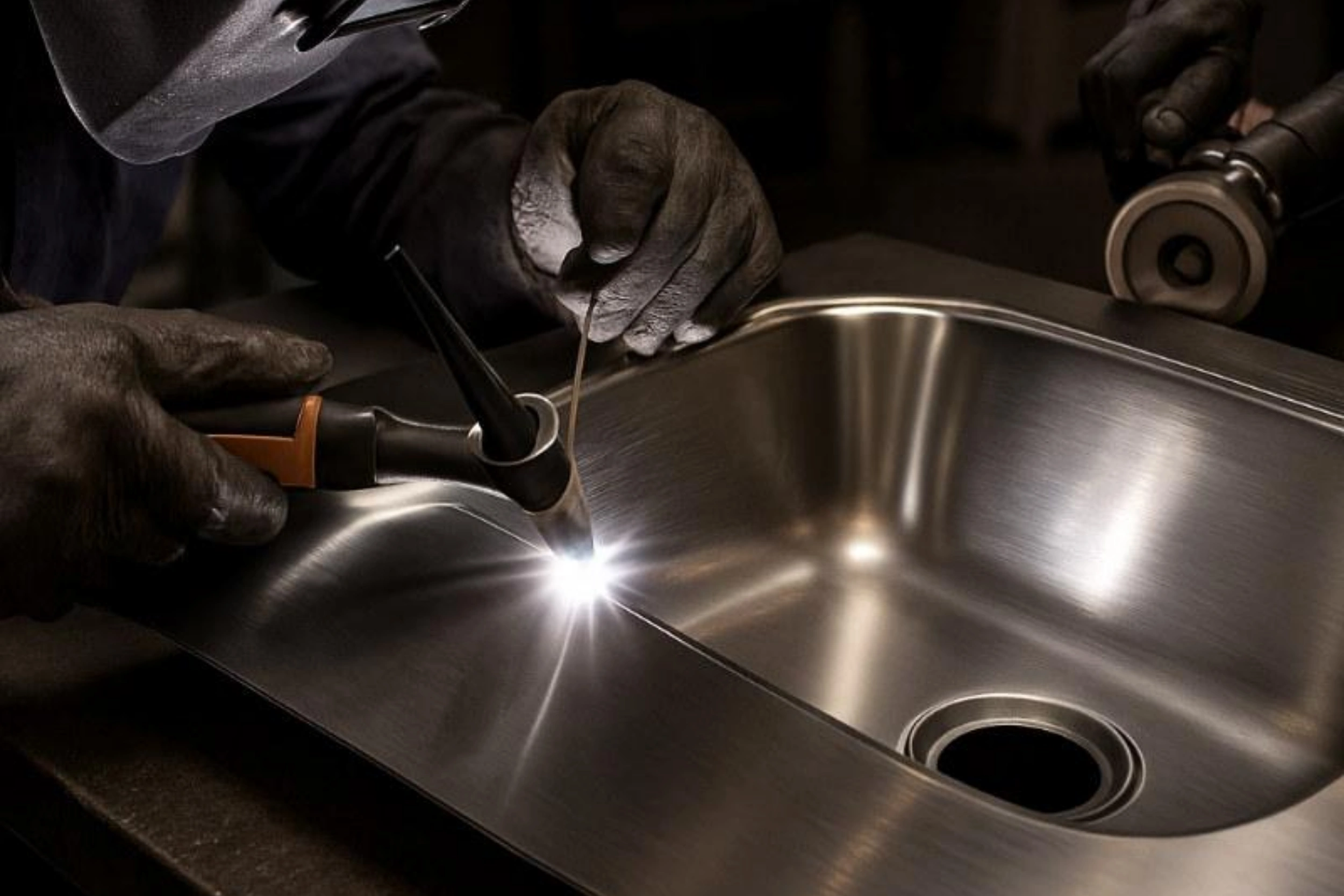


Not all stainless steel fabricators are the same and the difference usually doesn’t show up until after the job is finished. A weld that looked fine on day one starts to discolor. A “custom” piece turns out to be a modified standard product that never quite fits. A quote that seemed reasonable balloons once “extras” get added halfway through.
It’s tempting to treat stainless steel fabrication as a commodity: get three quotes, pick the cheapest, move on. But fabrication quality directly affects how long a product lasts, how well it performs under daily use, and whether it needs replacing in five years or twenty.
A poor weld on stainless steel doesn’t just look bad, it can compromise the material’s corrosion resistance at that exact point, creating a weak spot that fails long before the rest of the piece does. The cheapest quote often reflects shortcuts you won’t notice until they cost you more later.
Ask whether cutting, welding, and folding all happen under one roof, or whether your project gets passed between multiple external suppliers.
Every handoff is a chance for inconsistency, delay, and miscommunication. A fabricator who controls the full process from raw sheet to finished product can guarantee consistency in a way a broker simply can’t.
Stainless steel doesn’t behave like mild steel. It warps more easily under heat, and poor technique can damage the very corrosion resistance that makes it worth using in the first place.
A fabricator who specialises in stainless steel, not one who works with it occasionally alongside other metals will understand heat control, filler selection, and finishing in a way a generalist won’t.
A fabricator should be able to explain why they’re recommending a particular grade (304, 316, or otherwise) for your specific application, not just default to “stainless steel” as a catchall.
If your project involves coastal exposure, chemical contact, or strict hygiene requirements, the grade matters and a good fabricator will flag that upfront rather than after the fact.
“Custom fabrication” should mean designed and built from your brief, not a standard product with minor tweaks.
Ask to see examples of genuinely one-off work, not just variations on a catalogue item.
A fabricator confident in their pricing will give you a clear quote upfront, not a vague estimate that grows once work begins.
Straight answers about cost, timeline, and scope are a reasonable baseline expectation, not a bonus.
A fabricator who answers these clearly and confidently — without hesitation or vague deflection — is usually one worth trusting with your project.
None of these are dealbreakers in isolation, but more than one together is usually a sign to keep looking.
Everything above is exactly what we built our process around. Laser cutting, welding, and folding all happen in-house at our own workshop not spread across subcontractors.
Every weld is completed by tradespeople who specialise in stainless steel, not general metalwork. We work in 304, 316, and other grades depending on what your project actually needs, and we’ll tell you which one and why. And every quote is obligation-free, with no surprises once work begins.
Considering a project and want to see how this plays out in practice? [Get an obligation-free quote from our team →]
Ask to see examples of past one-off work, and ask specific questions about how a past project was designed — a genuine custom fabricator should be able to walk you through the process from brief to finished product.
Not necessarily, but material-specific experience matters. Ask how much of their work is specifically stainless steel, and how experienced their welders are with its particular behaviour under heat.
Not automatically. A lower price can reflect thinner material, less experienced labour, or shortcuts in finishing — all of which affect how long the product lasts. Compare quotes on scope and grade, not just the final number.
Most straightforward projects can be quoted within a day or two. More complex custom work may take longer to scope properly, but a fabricator should be able to give you a clear timeframe upfront.
Whether it’s a single precision piece or a full production run, our team cuts it accurately, in-house, every time.
* Your details are kept confidential